The Fifth Flavor: How Umami From Asian Kitchens Is Changing the Way America Cooks
You've probably had that moment. You take a bite of something — maybe a bowl of ramen, a spoonful of miso soup, or a forkful of a really good stir-fry — and you just stop. You chew slowly. You try to figure out what, exactly, is happening in your mouth. It's savory, sure. But it's more than that. It lingers. It makes you want another bite before you've even finished the first.
That feeling has a name: umami. And while Asian cooks have been harnessing it for millennia, American home kitchens are only just starting to catch up.
So What Actually Is Umami?
Umami is the fifth basic taste, alongside sweet, salty, sour, and bitter. The word itself comes from Japanese — umai (delicious) plus mi (taste) — and was identified by Japanese chemist Kikunae Ikeda back in 1908 when he isolated glutamate from kombu seaweed and realized it was responsible for a distinct savory sensation that didn't fit any existing taste category.
At the molecular level, umami is triggered primarily by glutamates — amino acids that occur naturally in a wide range of foods — and by nucleotides like inosinate and guanylate. When these compounds hit the taste receptors on your tongue, they produce that characteristic rich, full-bodied, almost round quality that food scientists describe as kokumi, or "mouthfulness."
Here's the kicker: glutamates are everywhere. Parmesan cheese is loaded with them. So are tomatoes, anchovies, mushrooms, and soy sauce. But traditional Asian cooking didn't just stumble onto umami-rich ingredients — it developed entire techniques specifically designed to concentrate and amplify these compounds.
The Building Blocks: Dashi, Gochujang, and More
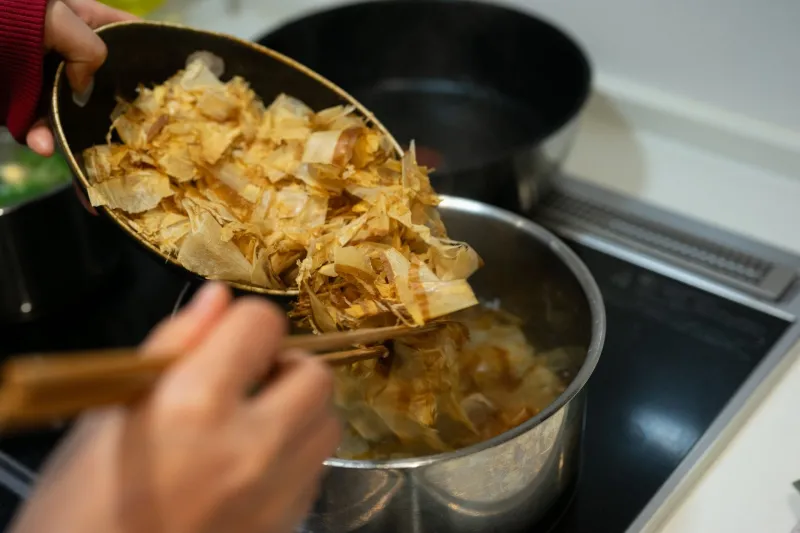
If there's a single recipe that illustrates umami's potential, it's Japanese dashi. This deceptively simple broth — typically made by steeping kombu (dried kelp) and katsuobushi (dried, fermented bonito flakes) in hot water — is the foundation of miso soup, ramen, and countless Japanese dishes. What makes dashi remarkable is the synergy between its two main ingredients. Kombu delivers glutamates; katsuobushi brings inosinate. Together, they create an umami effect that's actually stronger than either ingredient alone — a phenomenon food scientists call "umami synergy."
Korean cuisine takes a different but equally powerful approach through fermentation. Doenjang (fermented soybean paste) and gochujang (fermented chili paste) are both intensely umami-forward, thanks to the long fermentation processes that break down proteins into free glutamates. These pastes are the backbone of Korean cooking, adding complexity to stews, marinades, and dipping sauces in a way that's almost impossible to replicate with any Western substitute.
Chinese cooking contributes yet another angle: dried and fermented ingredients like dried shrimp, fermented black beans, and oyster sauce, all of which pack enormous umami density into small quantities.
Why American Cooks Are Finally Paying Attention
For a long time, the go-to umami boosters in American kitchens were things like Worcestershire sauce, ketchup, or the ever-controversial MSG — which, it's worth noting, is simply the sodium salt of glutamic acid and has been repeatedly cleared as safe by the FDA. But as global ingredients have become more accessible at mainstream grocery stores and online retailers, home cooks have started reaching for the real thing.
Chef and culinary educator Priya Nair, who teaches international cooking workshops in Chicago, has noticed a significant shift in her students over the past several years. "People come in wanting to understand why their homemade broth doesn't taste like the one at their favorite Japanese restaurant," she says. "Once they learn about dashi and umami synergy, it's like a light goes on. They stop chasing more salt and start chasing more depth."
Social media has played a role too. Videos of home cooks adding a sheet of kombu to their chicken stock or stirring a spoonful of white miso into their butter sauce have racked up millions of views, pulling these once-niche ingredients into the mainstream conversation.
Practical Ways to Add Umami to Your Everyday Cooking
You don't need to overhaul your pantry or enroll in culinary school to start cooking with more umami. Here are some genuinely easy entry points:
Start with miso. White (shiro) miso is mild and slightly sweet — perfect for beginners. Whisk a tablespoon into salad dressings, stir it into butter for finishing pasta, or blend it into a glaze for roasted vegetables. It adds a quiet, savory complexity that most people can't identify but everyone notices.
Keep a piece of kombu in your pantry. Drop it into your next pot of beans, vegetable broth, or even a pot of rice while it cooks. Remove it before serving. You won't taste "seaweed" — you'll just taste something that's noticeably more satisfying.
Experiment with gochujang. A small spoonful stirred into a burger patty mixture, a tomato-based pasta sauce, or a marinade for chicken thighs adds a fermented, slightly spicy depth that goes way beyond what chili flakes can do.
Try layering umami sources. The synergy principle means that combining different umami-rich ingredients creates a bigger effect than the sum of their parts. Try finishing a beef stew with a splash of soy sauce and a few drops of fish sauce. Neither flavor will dominate — the stew will just taste richer and more complex.
Don't be afraid of MSG. If you want to be direct about it, a small pinch of MSG (sold under brand names like Ajinomoto or available in many Asian grocery stores) is one of the most effective and honest ways to boost umami in any dish. It's the same compound found naturally in tomatoes and aged cheese, just in a more concentrated form.
The Bigger Picture
What's happening in American kitchens right now is more than a trend toward exotic ingredients. It's a fundamental shift in how home cooks think about flavor — moving away from the idea that more salt or more fat is always the answer, and toward a more nuanced understanding of taste chemistry that Asian culinary traditions have modeled for centuries.
The tools have always been out there. The fermented pastes, the dried seaweeds, the carefully tended broths — these aren't new inventions. They're the accumulated wisdom of food cultures that figured out how to make ingredients sing long before Western food science had language for what they were doing.
Now that we have the language — and the access — there's really no reason not to start cooking with it.