The Taste of Somewhere Else: Why Your Grandmother's Cooking Hits Differently Than Anyone Else's
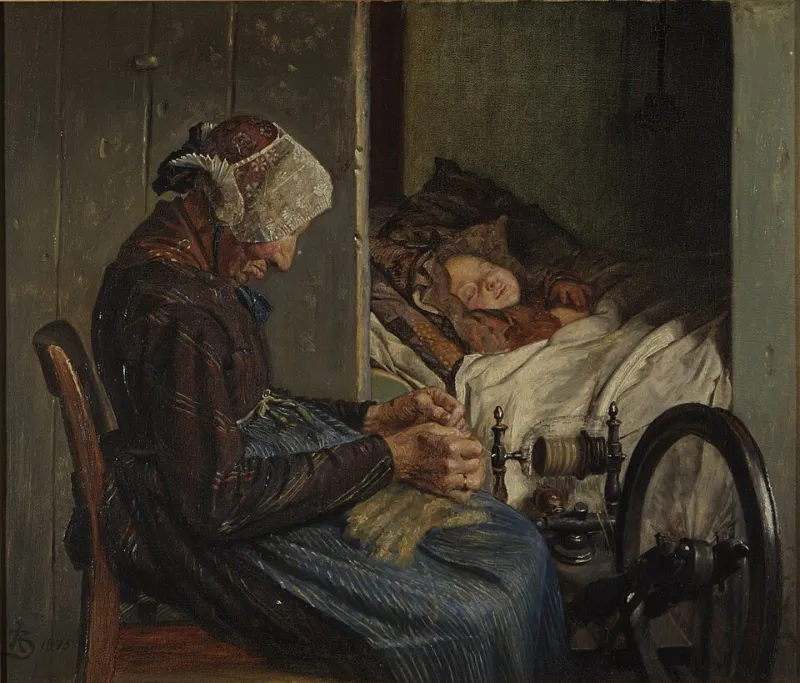
Photo: Kristian Zahrtmann, Public domain, via Wikimedia Commons
I've never been to Oaxaca. I've never stood in the kitchen of a farmhouse in Calabria or walked through a wet market in Guangzhou at dawn. But I've tasted all of those places — or something close to them — at the tables of people whose grandmothers came from those corners of the world.
There's a specific kind of food that only exists in the context of family. You can eat mole negro at the best restaurant in Mexico City and be genuinely moved by it. But the mole that a grandmother in Chicago makes for her grandchildren every Christmas, using a recipe she brought from Oaxaca in 1987, carried in her memory because she never thought to write it down — that version will taste different. Not necessarily better by any measurable culinary standard, but different in a way that goes beyond flavor.
Why is that? And what happens when those recipes start to disappear?
What's Actually Happening in Your Brain
Food memory is one of the most studied — and most emotionally loaded — areas of sensory psychology. The reason a specific dish can transport you so completely is rooted in neuroscience. Unlike other senses, smell and taste have a direct neural pathway to the hippocampus and amygdala — the brain regions responsible for memory formation and emotional processing. A single whiff of your grandmother's sofrito doesn't just remind you of her kitchen; it reconstructs the experience with a vividness that other memories rarely achieve.
This is sometimes called the Proust effect, named after Marcel Proust's famous passage in which the taste of a madeleine dipped in tea floods him with involuntary childhood memories. Researchers have since documented this phenomenon extensively, finding that food-triggered memories tend to be older, more emotionally positive, and more vivid than memories triggered by other sensory cues.
But here's the part that matters for how we understand family recipes: these memories aren't just personal. They're cultural. When a second-generation Korean American tastes her mother's doenjang jjigae, she's not only accessing her own childhood — she's touching something that connects backward through generations of women who cooked that same stew in circumstances she'll never fully know. The dish carries history that her own life experience can't contain.
The Recipe That Lives in the Hands
Ask anyone who has tried to replicate a beloved family recipe and they'll tell you the same thing: it never tastes quite right. You follow the instructions exactly — or as exactly as possible, given that many of these recipes were never formally written down — and something is still off. A little flat. A little less there.
Part of this is the obvious stuff: different ingredients, different equipment, different water. But food anthropologists and chefs who study traditional cooking point to something harder to quantify — the embodied knowledge that accumulates over decades of making the same dish.
A grandmother who has made tamales every Christmas for forty years doesn't think about how hard to work the masa or how much lard to add. Her hands know. That knowledge lives in muscle memory, in the feel of the dough, in a hundred micro-adjustments she makes without awareness. When she teaches her granddaughter, she can say "until it feels right" — and that instruction, frustrating as it is to a beginner, is actually the most accurate one she can give.
This is what food scholars call tacit knowledge, and it's one of the most fragile things that gets passed between generations. It can't be fully captured in a recipe card. It can only be transmitted through cooking alongside someone, enough times that your hands start to understand what hers already know.
Immigration and the Kitchen as Archive
For immigrant families in particular, the kitchen often becomes the most important archive of cultural identity. When you leave behind a country — voluntarily or not — you leave behind most of the physical markers of your culture: the landscape, the language heard on the street, the specific quality of light in the afternoons. Food is one of the few things you can take with you, and one of the few things that can recreate, however imperfectly, the sensory experience of a place you no longer live.
This dynamic plays out in immigrant communities across the United States every day. In Vietnamese American households, phở made from scratch on special occasions isn't just a meal — it's a ritual that connects the family to a Vietnam that may have changed enormously since they left, or that younger generations have never seen. In Ethiopian American communities, injera and the communal practice of eating from a shared platter carries social and cultural values about hospitality and togetherness that go far beyond the food itself.
Researchers who study food and diaspora note that recipes often become more carefully preserved after migration, not less. The distance from home makes the food feel more precious. A dish that would have been unremarkable in its country of origin — something you'd eat every Tuesday without thinking — becomes charged with meaning in a new country where it represents everything you came from.
And yet, inevitably, the food changes. American ingredients aren't quite the same. The specific variety of chile or the exact cut of meat isn't available, so substitutions are made. Over time, those substitutions become part of the recipe. The dish that a family calls "authentic" is often already a hybrid — a negotiation between memory and availability, between the old country and the new one.
When the Recipe Is Lost
The grief that comes when a family recipe disappears is real and recognized. Food psychologists describe it as a form of ambiguous loss — the feeling that something important is gone, but without a clear object to mourn. You can't attend a funeral for a recipe.
For many families, the loss happens gradually. A grandmother passes away before anyone thought to ask her to teach them. A mother who always cooked develops health issues that keep her out of the kitchen. A family scatters across different cities, and the annual gathering where the dish was made stops happening. The recipe exists in someone's memory, but imperfectly, and each attempt to reconstruct it feels like trying to remember a dream.
This is why food preservation projects — community cookbooks, oral history initiatives, platforms that document family recipes across cultures — matter beyond nostalgia. They're acts of cultural conservation. The Smithsonian's American Folklife Center has documented this for decades. Organizations within immigrant communities have been doing it informally for much longer, understanding intuitively that when the last person who knows how to make a dish is gone, something irreplaceable goes with them.
Why It Still Tastes Better
So we come back to the original question. Why does your grandmother's version taste better?
Some of it is the neuroscience — the memory pathway that makes emotionally significant food taste richer than it objectively is. Some of it is the tacit knowledge in her hands that your recipe card can't capture. Some of it is the specific circumstances of that kitchen, that afternoon, that table.
But a lot of it is something simpler and harder to articulate. When someone cooks for you using a recipe that came from their mother, who learned it from hers, who adapted it from the version she knew back home — you're eating time. You're eating the accumulated choices and improvisations and loves and losses of people you never met, translated into flavor.
No restaurant can replicate that. No recipe app, however sophisticated, can bottle it. It exists only in the transmission between people — in the act of standing next to someone in a kitchen, learning the feel of the dough, and eventually teaching someone else the same thing.
That's worth preserving. Whatever it takes.